7-8GHz High Gain Directional Antenna: The Precision Engine for Professional Microwave Links
Precision Engineering for Demanding Wireless Links
Establishing a reliable, high-capacity wireless connection over several kilometers is a significant engineering challenge. Professionals contend with formidable path loss at high frequencies, interference from other radio systems, and the constant need to maximize data throughput and link stability. Success in licensed point-to-point microwave bands, such as 7-8GHz, depends on one critical component: the antenna.
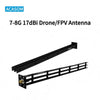
The ACASOM 7-8GHz High Gain Directional Antenna is engineered from the ground up to meet these exacting demands. It is not merely an accessory but the foundational element of your wireless bridge, transforming electrical signals into a tightly focused, efficient beam of radio energy. Designed for system integrators, network engineers, and communication specialists, this antenna delivers the precise combination of high gain, exceptional electrical efficiency, and rugged, lightweight construction required for mission-critical infrastructure.
Product Overview: The Cornerstone of Fixed Wireless Networks
At its core, this antenna serves a singular, vital purpose: to establish and maintain superior point-to-point or point-to-multipoint communication links within the 6800-8000MHz spectrum. Its value lies in a powerful synergy of features. It offers substantial signal amplification (gain) to combat distance, focuses that energy into a narrow beam for clarity and reach, and does so with minimal internal loss, ensuring every watt of power is utilized effectively. This makes it an ideal solution for building the backbone of modern fixed wireless access (FWA) networks, specialized sensor systems, and high-performance communication hubs.
In-Depth Analysis of Key Performance Features
Unmatched Signal Focus and Gain Stability
The antenna’s performance is defined by its impressive and stable gain. Reaching a peak gain of 17.39 dBi at 7400MHz and maintaining over 17 dBi across the entire 7-8GHz band, it provides the necessary "punch" to extend link ranges and support higher data rates. This consistent performance ensures reliable operation regardless of specific channel selection within the band.
However, raw power is only half the equation. The antenna’s narrow 3-dB beamwidth of 24° in both the E-plane and H-plane is what truly sets it apart. Imagine the difference between a floodlight and a laser pointer. This focused beam provides exceptional directivity, allowing for precise targeting of a distant receiver. This focus translates directly into three key benefits:
-
Increased Effective Range: Concentrated energy travels further with less dispersion.
-
Superior Interference Rejection: By not radiating energy widely, it is less susceptible to picking up unwanted signals from other directions, enhancing link clarity.
-
Enhanced Frequency Reuse: Network planners can install multiple links in closer proximity without them interfering with each other, optimizing infrastructure.
Superior Electrical Efficiency and System Protection
A high-gain antenna is futile if it wastes power internally or reflects it back into the radio. This is where the antenna's exceptional Voltage Standing Wave Ratio (VSWR) comes into play. VSWR measures impedance matching; a perfect match is 1.0. The ACASOM antenna achieves a remarkable typical VSWR of 1.07 and guarantees a maximum below 1.5.
Why does this matter? A low VSWR ensures maximum power transfer from the radio transmitter to the antenna, with minimal signal reflected back. This not only improves overall system efficiency but also protects sensitive and expensive radio equipment from potential damage caused by reflected power. Coupled with a radiation efficiency ≥90%, this antenna is designed to be an exceptionally efficient transducer of energy.
Mechanical Design for Simplified Real-World Deployment
Performance must be paired with practical deployability. Weighing a mere 29 grams (0.027 kg), this ultra-lightweight design addresses critical installation challenges. It significantly reduces wind load and mechanical stress on mounting poles or masts, allows for use with lighter and less expensive positioning hardware, and simplifies the handling and alignment process for technicians. Despite its light weight, the implied build quality from its specifications ensures it is constructed to withstand the environmental rigors of permanent outdoor installation.
Complete Technical Specifications
| Parameter | Specification |
|---|---|
| Frequency Range | 6800 - 8000 MHz |
| Peak Gain | 17.39 dBi @ 7400MHz |
| Typical Gain | >17 dBi across band |
| VSWR (Typical / Max) | 1.07 / <1.5 |
| Efficiency | ≥90% |
| Polarization | Vertical |
| 3-dB Beamwidth (E & H Plane) | 24° |
| Front-to-Back Ratio | 20 dB |
| Input Impedance | 50 Ω |
| Power Handling | 30 W |
| Connector | SMA-Female |
| Dimensions (L x W x H) | 320 x 40 x 30 mm |
| Weight | 29 g |
Target Applications & Professional Use Cases
-
Licensed Fixed Wireless & Backhaul Links: The primary application. This antenna is ideal for creating the backbone links for Internet Service Providers (ISPs), connecting cellular base stations, or establishing secure building-to-building networks over several kilometers, where licensed spectrum ensures a clean operating environment.
-
Radar & Sensor Systems: Its precise frequency range and focused beam make it suitable for integration into various radar systems and specialized sensor platforms used in industrial monitoring, environmental sensing, or security applications.
-
Satellite Communication (Satcom): Can be employed in specific ground station roles, such as feeder links or for dedicated data downlink terminals operating within the 7-8GHz band.
-
High-Performance Testing & Measurement: Serves as an excellent tool in research & development labs or field testing setups where a calibrated, high-gain source or receive antenna is required.
Installation and Alignment Best Practices
To unlock the full potential of this precision instrument, correct installation is paramount:
-
Path Planning: Prior to installation, conduct a thorough site survey to ensure a clear Fresnel zone free of obstructions.
-
Polarization Alignment: Crucially, both ends of the link must use the same polarization (vertical, in this case). Mismatched polarization leads to severe signal loss.
-
Precision Mounting & Aiming: Use sturdy, non-corrosive hardware. Achieving alignment for a 24° beamwidth requires care. Utilize the radio’s received signal strength indicator (RSSI) or a portable spectrum analyzer to meticulously peak the signal for maximum strength.
-
Weather Sealing: While the antenna is robust, always use weatherproof sealing tape (e.g., coaxial sealant tape) on the connected SMA connector and cable to prevent moisture ingress, which can degrade performance over time.
Performance Comparison: Focused Directionality vs. Conventional Options
Understanding the trade-off is key. Compared to an omni-directional antenna with similar gain, this directional model offers a decisive advantage for point-to-point links.
| Feature | ACASOM 7-8GHz Directional Antenna | Theoretical Omni-directional Antenna |
|---|---|---|
| Radiation Pattern | Focused beam (24°) | Radiates equally in all directions |
| Effective Link Range | Much Greater | Limited |
| Interference Immunity | Excellent (high front-to-back ratio) | Poor (receives noise from all sides) |
| Co-location Ability | High (multiple links possible in close proximity) | Very Low |
Conclusion: For dedicated, long-distance links, a high-gain directional antenna is not merely an improvement; it is an essential requirement for a stable, efficient, and professional-grade system.
Frequently Asked Questions (FAQ)
Q: What is the maximum distance this antenna can cover?
A: Distance is determined by the complete "link budget," which includes transmitter power, receiver sensitivity, cable loss, and environmental factors. The antenna's high gain and low VSWR directly and significantly increase this budget, enabling reliable links over many kilometers under clear line-of-sight conditions.
Q: Is it suitable for permanent outdoor installation?
A: Yes. Its specifications indicate an industrial-grade build. For long-term reliability, ensure it is paired with properly rated outdoor coaxial cable and that all connectors are thoroughly weather-sealed.
Q: What type of cable should I use with the SMA-F connector?
A: Use high-quality, low-loss coaxial cable specifically rated for frequencies up to 8GHz and beyond. Cable loss increases with frequency, so premium cable is a wise investment to preserve the antenna's performance.
Q: How critical is the alignment process?
A: Extremely critical. The narrow 24° beamwidth means that even a few degrees of misalignment can result in a substantial drop in received signal strength. Precise alignment using the correct tools is essential for optimal performance.
Conclusion: The Definitive Choice for Critical Communication Links
The ACASOM 7-8GHz High Gain Directional Antenna embodies the precision and reliability required for modern professional microwave communications. By mastering the balance between concentrated power, exemplary electrical efficiency, and practical, lightweight design, it solves the core challenges faced by network builders. For engineers and integrators who cannot compromise on the quality and stability of their wireless links, this antenna stands as a pivotal component in designing systems that are not just functional, but exceptional. Invest in the foundation of your network; choose the antenna engineered for clarity, range, and unwavering performance.