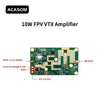
ACASOM 6000-7000MHz 50W Unidirectional Amplifier: The Cornerstone of Mission-Critical Wireless Links
Conquering the High-Frequency Frontier: The Demand for Robust Signal Integrity
In the realm of professional wireless communications, operating within higher frequency bands such as 6-7GHz presents a unique paradox. These frequencies offer cleaner spectrum and capacity for high-bandwidth data, but they come with a significant physical challenge: pronounced path loss. Signals attenuate rapidly with distance and are more susceptible to absorption by environmental obstacles. For applications demanding reliable, long-range control links, high-definition video feeds, or real-time telemetry data, standard amplification solutions often hit a performance wall precisely when it matters most.
This is where raw, intelligently managed power becomes non-negotiable. The ACASOM 6000-7000MHz 50W Unidirectional Amplifier is engineered not as an incremental upgrade, but as a foundational component for systems where link reliability is paramount. It is designed for integrators and operators who cannot afford dropouts, whose missions depend on the unwavering clarity and reach of their wireless command and data pipeline.
Engineering Philosophy: Where High Power Meets High Fidelity
The core design objective of this amplifier transcends simply boosting signal strength. It is built on a triad of principles essential for professional deployment:
-
Uncompromising Output Power: To dramatically extend the operational envelope and overcome the inherent losses of the 6-7GHz band.
-
Signal Purity Preservation: To ensure the amplified output is a clean, accurate representation of the input, crucial for digital data integrity.
-
Thermal and Operational Resilience: To guarantee consistent performance under continuous load in diverse and challenging environmental conditions.
Decoding the Performance Specifications: A Technical Deep Dive
Industry-Leading 50W Output with Intelligent Efficiency
The headline specification is the 47dBm (50 Watt) saturated output power. This formidable power level provides a massive boost to the system's link budget, directly translating to exponentially greater reliable range or the ability to maintain a robust connection through obstructive environments.
However, generating high power is one challenge; doing it efficiently is another. The amplifier's 45% Power Added Efficiency (PAE) is a critical figure of merit. This high efficiency means more of the consumed DC power is converted into useful RF energy, with less wasted as heat. The direct benefits are:
-
Reduced Thermal Stress: Less heat generation prolongs component life and enhances long-term reliability.
-
Lower Power Supply Demand: It eases requirements on system power supplies and batteries, crucial for mobile or remote deployments.
-
Simplified Thermal Management: While still necessary, the required heat sinking or active cooling can be less aggressive than with a lower-efficiency unit of similar power.
Exceptional Signal Fidelity and Gain Stability
For modern digital communications, signal distortion is as detrimental as weakness. This amplifier excels in maintaining signal quality.
-
±0.5dB Gain Flatness: This specification ensures that the amplification factor is consistent across the entire 1000MHz bandwidth (6000-7000MHz). There is no significant boosting of one frequency at the expense of another, preventing distortion of wideband or frequency-hopping signals.
-
40±1dB High Gain with Excellent Input Match: A stable, high gain of 40dB provides substantial amplification for even weak input signals. Coupled with a strong Input Return Loss of -15dB, it ensures maximum power transfer from the source transmitter and minimizes harmful reflections that could damage sensitive upstream components.
Ruggedized Construction for Demanding Deployments
Performance must be housed in a package built for the real world.
-
Robust Aluminum Enclosure: The housing provides superior electromagnetic shielding, structural durability, and acts as an integral heat spreader to dissipate thermal energy.
-
Compact and Lightweight Form Factor: Measuring only 132x53x17mm and weighing 0.21kg, it is designed for seamless integration into crowded equipment racks, mobile platforms, or field-deployable cases.
-
Extended Temperature Range ( -30°C to +85°C ): This range guarantees operational integrity from freezing cold to desert heat, supporting 24/7 outdoor or vehicular installations without performance derating.
Complete Technical Specifications
| Parameter | Specification |
|---|---|
| Frequency Range | 6000 - 7000 MHz |
| Output Power (P1dB) | 47 dBm (50 W) |
| Gain | 40 ±1 dB |
| Power Added Efficiency | 45% @ 47dBm |
| Operating Voltage | 28 V DC |
| Current Consumption | 3.6 A @ 47dBm |
| Input Return Loss | -15 dB |
| Gain Flatness | ±0.5 dB |
| RF Connectors | SMA-Female (Input & Output) |
| Operating Temperature | -30°C to +85°C |
| Dimensions (L x W x H) | 132 x 53 x 17 mm |
| Weight | 0.21 kg |
Core Application Scenarios: Enabling Critical Operations
-
Professional Long-Range Remote Operations: For systems requiring control and data links far beyond standard visual range, this amplifier provides the essential RF "muscle" to bridge distances of several kilometers while maintaining low latency and high data integrity.
-
Industrial Inspection and Monitoring: In applications such as infrastructure surveying, pipeline patrol, or renewable energy farm inspection, it ensures that high-definition video and sensor data from remote platforms are transmitted back to the operations center without interruption, regardless of range or minor obstructions.
-
High-Resolution Aerial Mapping and Surveying: When capturing large-area geospatial data, a lossy data link can compromise an entire mission. The robust downlink supported by this amplifier safeguards the real-time transmission or backup of valuable captured data.
-
Fixed Wireless Access and Point-to-Point Links: Serves as a reliable power stage for establishing high-capacity, short-to-medium-haul communication bridges in the 6GHz band, where spectrum licensing may be favorable.
System Integration, Power, and Thermal Management Guide
Successful deployment hinges on proper integration:
-
Power Supply Requirements: A stable, well-regulated 28V DC supply capable of delivering at least 5-6A continuously is recommended to handle the peak current draw and ensure clean operation. Ripple on the supply line should be minimized.
-
RF Interfacing: Use high-quality, low-loss coaxial cables rated for frequencies up to 7GHz or higher. Properly torque SMA connectors to ensure a reliable connection and maintain impedance matching. Always connect the antenna before applying power.
-
Thermal Management is Critical: The amplifier must be mounted to a substantial heatsink or a thermally conductive chassis. For continuous full-power operation, active cooling (e.g., a fan) is strongly advised. Monitoring the baseplate temperature during initial testing is recommended to validate your thermal design.
Performance Comparison: Understanding the 50W Advantage
Choosing this amplifier is a decision for maximum performance. Compared to a typical 10W or 20W amplifier:
-
Link Budget Improvement: Provides a 3-7 dB advantage in output power, which can double or more than quadruple the effective communication range, all else being equal.
-
Signal-to-Noise Ratio (SNR): Delivers a stronger signal at the receiver, significantly improving SNR and resistance to interference.
-
System Redundancy: Offers substantial power headroom, allowing the system to maintain a clear link even under suboptimal conditions like inclement weather or unexpected obstruction.
Frequently Asked Questions (FAQ)
Q: Is this a transmit-only (Tx) amplifier?
A: Yes, it is a unidirectional power amplifier designed specifically for the transmit path. A separate low-noise amplifier (LNA) would be required to enhance the receive sensitivity on a bidirectional link.
Q: Can it be used with any 6GHz transmitter?
A: It is compatible with any transmitter operating within 6000-7000MHz that provides an output signal within its operational input range (typically around 0 to +10 dBm for full saturation). Always verify the output power of your source device.
Q: How do I manage the significant heat output?
A: As outlined, a combination of a large aluminum heatsink, conductive mounting, and forced air cooling is essential for sustained high-power operation. The unit should not be operated in a sealed, unventilated enclosure.
Q: Are there licensing requirements for operating at 50W in this band?
A: Radio frequency licensing regulations vary significantly by country and region. It is the responsibility of the system integrator and end-user to ensure compliance with all local regulatory requirements for transmit power, frequency use, and equipment certification.
Conclusion: Investing in Communications Infrastructure Resilience
The ACASOM 6000-7000MHz 50W Unidirectional Amplifier is a specialized tool for a specific class of challenges. It is the solution selected when the cost of a failed communication link—whether measured in lost data, operational downtime, or mission failure—far outweighs the investment in robust hardware.
For system architects and operators engineering solutions for critical data links, this amplifier provides a bedrock of performance. It transforms challenging high-frequency, long-distance communication from a technical uncertainty into a reliable, managed asset. By delivering unparalleled power with fidelity and resilience, it empowers professionals to push the boundaries of their wireless systems with confidence.